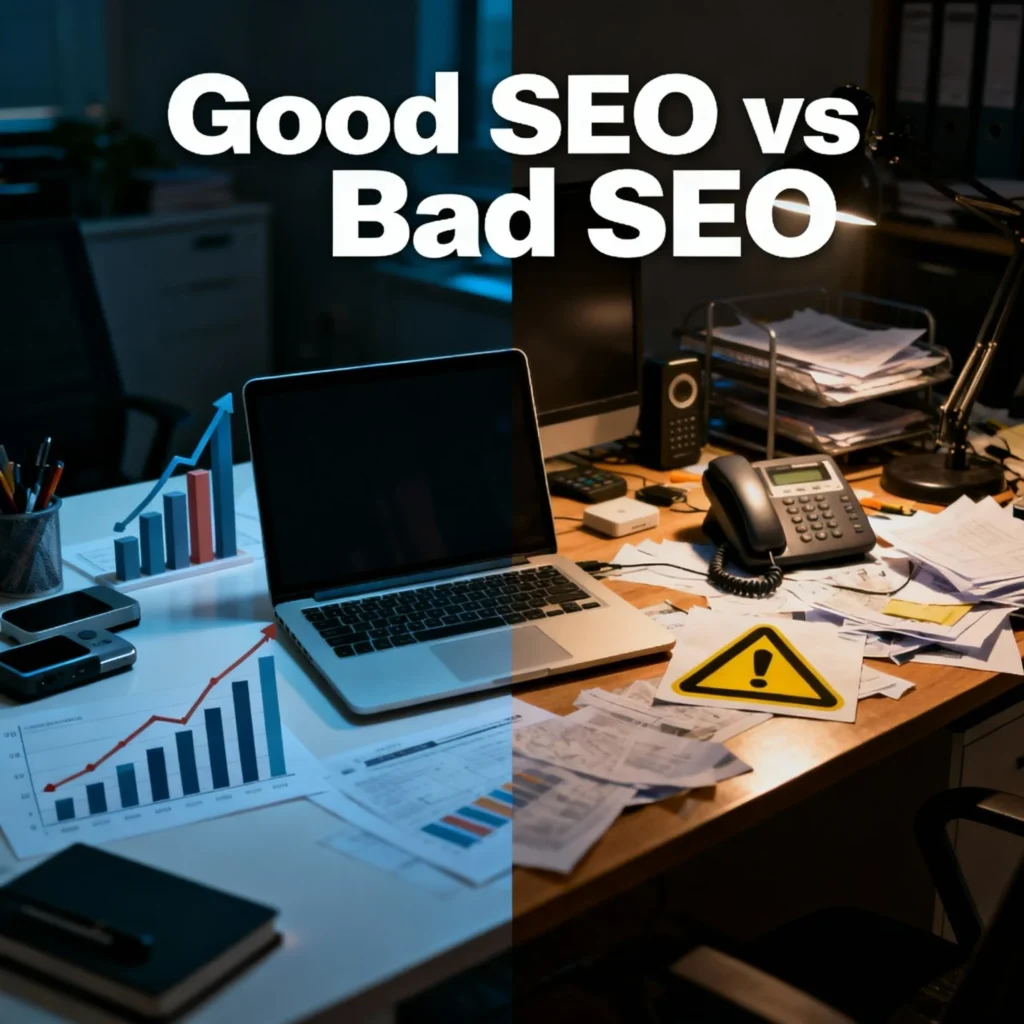
When we talk about SEO on Google, there’s always a battle going on — good SEO vs bad SEO. Everyone wants to rank higher, but not everyone knows the right way to do it. Some follow good SEO practices that Google actually loves, while others take shortcuts and end up doing bad SEO that hurts them more than it helps.
So let’s make it simple: in this blog, you’ll learn how good SEO looks on Google, how bad SEO destroys rankings, and what you can do today to move your site toward better Google results. We’ll compare both sides honestly — with examples, practical tips, and a friendly explanation that makes sense even if you’re new to SEO.
1. What Is SEO on Google and Why Does It Matter?
Let’s start with the basics. SEO — or Search Engine Optimization — is the process of improving your website so that Google understands it, trusts it, and shows it to people searching for what you offer.
Now, here’s the tricky part: everybody wants that #1 position on Google, but not everybody plays fair.
- Good SEO focuses on creating valuable, honest, and useful content.
- Bad SEO focuses on trying to “game” Google’s algorithm with tricks and spammy tactics.
Google’s mission is clear — to give users the best possible experience. So if your website helps people and delivers value, you’re already doing good SEO. But if your website is stuffed with random keywords, fake backlinks, or copied text, that’s bad SEO, and Google will push you down.
2. What Does Good SEO Look Like on Google?
A good SEO strategy is built on trust, quality, and consistency. It doesn’t try to cheat Google — it works with Google.
Here’s how good SEO looks in action:
- Your website loads fast, both on mobile and desktop.
- Your content feels fresh, helpful, and easy to read.
- You naturally use keywords like “SEO,” “Google,” “ranking,” “traffic,” and “content,” without overstuffing.
- You answer your audience’s questions clearly and completely.
- You get backlinks from trustworthy websites — not shady link farms.
- You care about your reader, not just the algorithm.
When you do all this consistently, Google rewards you with higher rankings, better visibility, and more traffic.
Good SEO = Long-term growth, brand trust, and happy visitors.
3. What Does Bad SEO Look Like on Google?
Let’s be honest — we’ve all seen websites that look spammy, confusing, or outdated. That’s usually the result of bad SEO.
Bad SEO is like trying to fool Google into thinking your site is valuable when it’s not. It might give you a short-term bump, but eventually, Google catches on — and when it does, rankings crash fast.
Here are the biggest red flags of bad SEO:
- Keyword stuffing (using “SEO,” “Google,” or “ranking” in every sentence).
- Buying backlinks from low-quality or irrelevant sites.
- Using copied or AI-generated content without adding real value.
- Writing for bots instead of people.
- Ignoring mobile optimization or user experience.
- Skipping proper headings, titles, and meta descriptions.
When you rely on these bad SEO tricks, you might fool Google for a moment, but you’ll lose trust quickly. Google’s algorithm is smarter than ever, and it can easily detect unnatural content or manipulative behavior.
Bad SEO = Short-term gains, long-term pain, and damaged reputation.
4. The Core Difference Between Good SEO and Bad SEO
Here’s the simplest way to understand the difference:
| Aspect | Good SEO | Bad SEO |
|---|---|---|
| Goal | To help users and provide value | To trick Google |
| Content Style | Informative, readable, and natural | Repetitive, keyword-stuffed |
| Backlinks | Earned from authority sites | Bought or spammed |
| User Experience | Prioritized and tested | Ignored completely |
| Results | Sustainable growth | Short-lived spikes |
| Google’s Reaction | Rewards with higher rankings | Penalizes or demotes site |
So, if you want your website to thrive on Google, your goal should always be creating helpful content that solves real problems — that’s what good SEO is all about.
5. How Google Detects Good SEO vs Bad SEO
Now, you might be wondering: how does Google even tell the difference?
It’s simple — Google watches how users behave on your site.
If visitors stay longer, click more, and share your pages, it’s a signal of good SEO.
But if they bounce away quickly, it tells Google your page didn’t help — that’s a sign of bad SEO.
Some of Google’s ranking factors that reward good SEO include:
- High-quality content that matches user intent.
- Mobile friendliness and fast load times.
- Clean website structure that helps crawlers navigate.
- Secure HTTPS connection.
- Engagement signals like comments, shares, and time spent on site.
Meanwhile, bad SEO practices like spammy backlinks, duplicate content, or hidden text trigger penalties or ranking drops.
Remember: Google updates its algorithm thousands of times a year to detect and remove bad SEO. But good SEO always survives because it’s built on genuine quality.
6. How to Do Good SEO for Better Google Rankings
If you want to focus on good SEO and earn better rankings on Google, follow these simple but powerful steps:
- Create Valuable Content First
Always start with your audience. Answer real questions, solve real problems, and share practical advice. - Use Keywords Naturally
Include your focus keywords like “good,” “bad,” “SEO,” and “Google” where they fit naturally — in headings, subheadings, and paragraphs — but never force them. - Optimize Titles and Meta Descriptions
A good title should describe your topic clearly. For example: “Good SEO vs Bad SEO on Google: What You Need to Know.” - Make It Mobile-Friendly
More than 60% of Google searches come from mobile. A good SEO site must look and work great on all devices. - Improve Page Speed
Use lightweight images, clean code, and caching. Google ranks faster sites higher. - Build Honest Backlinks
Guest post, collaborate, and earn mentions from trustworthy websites. - Keep Learning
SEO is always evolving. Follow Google’s updates, read SEO blogs, and keep improving your strategy.
These steps might sound simple, but they’re exactly what separates good SEO from bad SEO in Google’s eyes.
7. How Bad SEO Can Damage Your Google Ranking
If you still think bad SEO isn’t a big deal — think again.
Google’s penalties can destroy your visibility overnight.
Here’s what happens when you keep using bad SEO tactics:
- Your site gets flagged as spam or irrelevant.
- You lose organic traffic.
- Your domain authority drops.
- Even your ads and local rankings can suffer.
Once Google distrusts your website, it takes months — sometimes years — to rebuild that trust. That’s why doing good SEO from day one saves you time, money, and reputation.
8. Real Examples: Good SEO vs Bad SEO in Action
Example of Good SEO:
A travel blogger writes a 2000-word guide titled “10 Hidden Beaches in Goa You Must Visit.” It includes original photos, proper headings, and keywords like “best beaches,” “Goa travel,” and “Google travel search.” The content is helpful and authentic. Google ranks it high.
Example of Bad SEO:
Another site copies the same list, repeats the word “Goa” 100 times, adds fake backlinks, and hides keywords in white text. It might get a few clicks at first, but soon Google catches it — and the site disappears from search.
Good SEO wins every time because it builds trust. Bad SEO only builds temporary noise.
9. Things to Avoid If You Want Better Google Ranking
If you truly care about ranking better on Google, avoid these bad SEO habits:
- Over-optimizing keywords.
- Ignoring readability.
- Buying traffic or fake engagement.
- Using clickbait headlines.
- Forgetting about image alt tags.
- Skipping analytics or performance tracking.
Avoiding these bad habits instantly pushes your website closer to good SEO territory.

10. Why Good SEO Is an Investment, Not an Expense
A lot of people see SEO as a cost. In reality, good SEO is an investment that multiplies your returns.
When you invest time in doing it right — creating better content, improving structure, and earning Google’s trust — your website keeps attracting traffic for years.
Meanwhile, bad SEO is like borrowing money from your future. You might gain a few quick clicks now, but you’ll pay heavily when Google updates its algorithms.
So, always choose patience, quality, and honesty over shortcuts. That’s how you build a brand Google respects.
11. Final Words: Good SEO Always Wins on Google
In the end, good SEO vs bad SEO isn’t just a technical debate — it’s about mindset.
If you create for people first and Google second, your rankings will naturally rise.
If you chase shortcuts, your success will always be temporary.
Good SEO builds trust, authority, and visibility.
Bad SEO builds penalties, frustration, and wasted effort.
So next time you plan your content, think like Google.
Ask yourself: “Does this help someone?”
If the answer is yes — congratulations, you’re doing good SEO.




Leave a Comment